Disclaimer: All information posted is merely for educational and informational purposes. It is not intended as a substitute for professional advice. Should you decide to act upon any information on this website, you do so at your own risk. While the information on this website has been verified to the best of Ara Counseling’s abilities, Ara Counseling cannot guarantee that there are no mistakes or errors. Ara Counseling reserves the right to change this policy at any given time, of which this website will be promptly updated. If you want to make sure that you are up to date with the latest changes, Ara Counseling advises you to frequently visit this page.
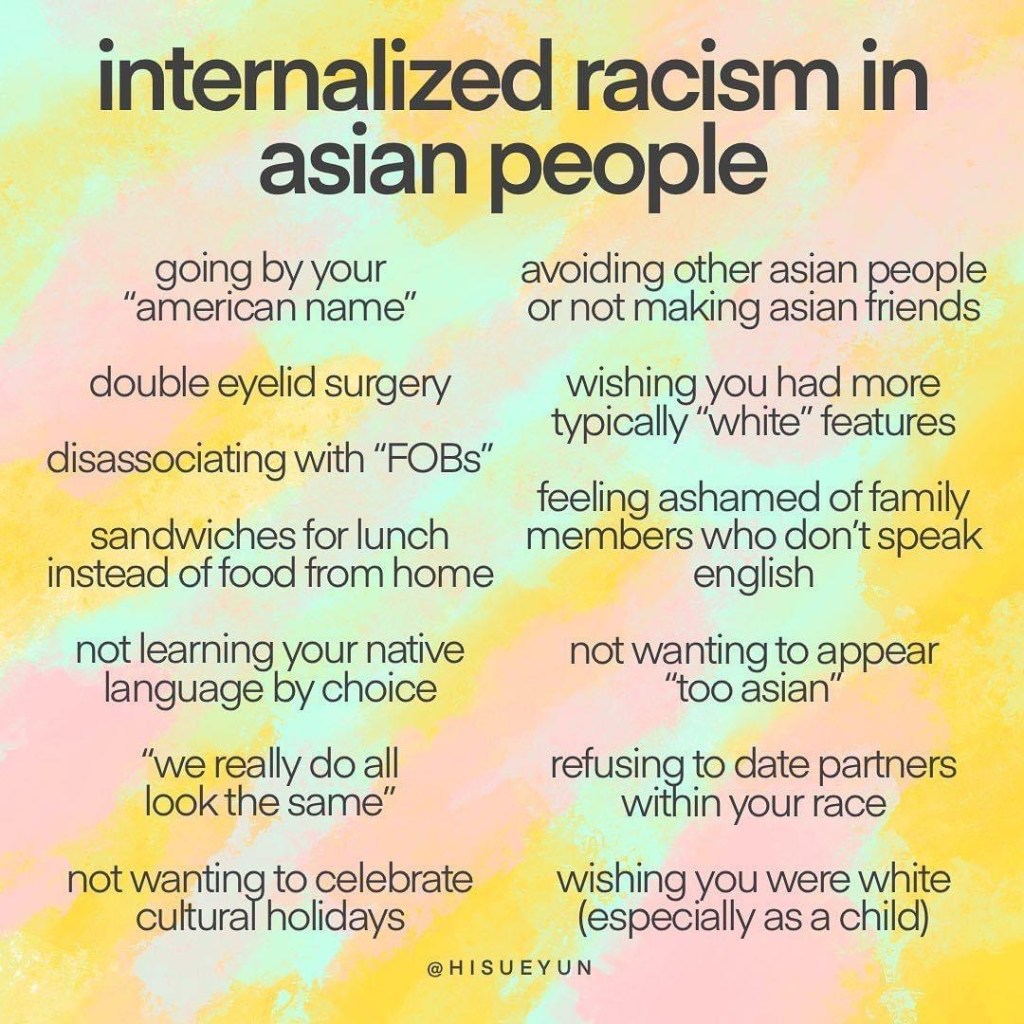
In lieu of Asian American Heritage Month, I thought that it would be okay if I continued the topic of the Asian American experience. A few days ago, I ran across this image on Facebook. It had been shared by another Hmong marriage and family therapist. After reading all the bullet points, it got the gears in my head going.
#1 – Going by your “American Name”
Growing up, I had wished that my parents had given me an American name instead of a Hmong name. I hated the fact that the teachers and substitute teachers were always pronouncing my name wrong. I tried to give myself a nickname that was American but nothing ever stuck so I gave up. It wasn’t until I was an adult that I finally accepted my name and learned to like it.
#2 – Double Eyelid Surgery
This point didn’t apply to my experience because I have double eyelids already.
#3 – Sandwiches for lunch instead of food from home
This point didn’t apply to me. My parents weren’t well off so we received free lunch at school. So it never crossed my mind that I wanted to pack my own food. Free food was good enough for me.
#4 – Not learning your native language by choice
I wouldn’t say that I refused to learn my native language; it was more along the lines of refusing to speak my native language. I remember specifically in the 7th grade when I lied that I didn’t know how to speak Hmong because I didn’t want people speaking to me in Hmong or having to speak to others in Hmong. It wasn’t until I was in high school that I started speaking more Hmong to my friends. Even now, I see that my own children refuse to speak Hmong. They understand it, but they will only respond in English.
#5 – We really do all look the same
I never believed this.
#6 – Not wanting to celebrate cultural holidays
This point was iffy for me. I can’t tell if my refusal was due to internal racism OR if it was due to rebelling against my mom. Up until high school, I hated wearing traditional Hmong clothing to the Hmong New Year. However, I am leaning more towards rebelling against my mom since she always picked out the traditional outfits that I would wear which ended up with me being layered under so many clothing and accessories. My neck would hurt for days afterwards due to the heavy traditional necklace. When I was in high school, I started picking my own traditional outfits to wear and it was much lighter, so I enjoyed it.
#7 – Avoiding other Asian people OR not making Asian friends
The only time I can think of that I had somewhat of this experience was in the 7th grade. However, I believe it was because there weren’t many Asian people in my classes, and it was a new school to me. I remember that by the end of the 7th grade, about 75% of my friends were Asian.
#8 – Wishing you had more typically “White” features
This point was also iffy for me as well. When I was growing up, I had wished that I had a more “white” nose. However, I think this was more because of the fact that many of my aunts told me that I didn’t have a nice nose bridge and that it was too flat. Even after I married my husband, his relatives have expressed the same thing to me as well.
#9 – Feeling ashamed of family members who don’t speak English
YES, 100%. When I was between the ages of 10-12, I was very embarrassed of my parents because they both spoke broken English.
#10 – Not wanting to appear “too Asian”
I don’t remember ever having this thought.
#11 – Refusing to date partners within your race
No, I exclusively only dated Hmong men. I know there were many White men who fancied me and tried to date me, but I always turned them down. One of the main reasons was I couldn’t tell if these White men actually liked me because they were physically and emotionally attracted to me or if they had a fetish for Asian women.
#12 – Wishing you were White (especially as a child)
YES! When I was young, I had always wished that I was white. I wanted blonde hair and blue eyes. I wanted to blend in. I hated standing out. It wasn’t until I was in high school that I started to love who I was and my cultural heritage.
I am pretty sure that there are probably more bullet points that can be added to the list of internalized racism that individuals experience. These were the ones that this particular individual picked out and listed. I honestly agree with with these because even though I didn’t personally experience them, I have watched my Asian friends and family members experience them. Honestly, I believe that one of the causes of internalized racism stems from the idea of a “melting pot.” Instead of teaching individuals to embrace their cultural heritages, the American society teaches individuals to strip themselves of their ancestry and to adhere to certain morals, values, and ideals in order to be “true Americans.”
Honestly, I don’t even remember how or when I had a shift in my thoughts and feelings regarding the Hmong culture. All I remember was that I was still in high school and had an epiphany. I started learning more about Hmong history, culture, and traditions. Then I learned how to segregate people’s behaviors and opinions from the actual traditions. After completing my master’s degree, I learned how historical intergenerational trauma had impacted our Hmong community which had a trickle effect on our culture, traditions, beliefs, morals, values, behaviors, etc. This I will save for another blog.
Therefore, what I strive to do in my work with young Hmong American adults and my children is to teach them about the beauty of the Hmong culture, traditions, and history while informing them of the trauma that has impacted the Hmong community that resulted in negative traumatic experiences that have been carried from generation to generation.
I am not perfect. My opinions and views on racism are based on my personal experiences, experiences of individuals around me, and what I have learned in the academic setting. I understand that I still have a long ways to go in regards to understanding racism and fighting for justice. I simply hope that this blog gave you some positive insight into internalized racism and to jumpstart your own evaluation/thoughts/opinions on internalized racism.
 ARA COUNSELING